Showing posts with label traditional arts. Show all posts

Monday, March 9, 2009

Textiles: Hill tribe weaves

Getting back to posting about Textile traditions from Asia. This one is  about the most vibrant, most eclectic and most lovingly preserved traditions one will encounter. The hill tribe weaves from Indochina. 


An intricate  flower Hmong blanket  with extensive embroidery ,
 applique and batik used as alternately a throw or coverlet in the bed room.


Indigo dyed Black Hmong clothing from Vietnam. The collar, belt and sleeves are worked in
  cross-stitch and applique and attached  to the main garment later.


The hill tribe people from the region are diverse- almost 50 from Vietnam alone.  They present a mind boggling diversity in attire, practices customs and traditions. It is impossible for the casual visitor to illustrate the whole gamut in a single blog post, it is more a subject for a serious ethnographer.

What unifies the vast number of ethnic people spread across Burma, Thailand, Vietnam, Laos and even China, to my mind is their love for textiles.  Each minority is easily identifiable with their dress Most of them derive their names from the particular style of clothing they wear - Black Hmong, Flower Hmong, Red Dzao or Yao, White-trouser Yao so on. 


One of the more vibrant tribes, Red yao, or Dzao clothing. Remarkable for their  detachable aprons and belts worked with embroidery, applique and liberal use of woolen and metallic embellishment.


Flower Hmong blanket used as a window runner in the study room

The garments are made by the women. Harvesting  and weaving the hemp,  breeding silkworms, applying indigo dye, producing the batik designs, embroidering  and sewing the garment and embellishing them with pompoms, shells and sequins, a virtually limitless  range of techniques go into producing colorful and flamboyant dress which are utilitarian, ecologically-kind and expressive.
Have posted illustrations of the Black Hmong and the Red Yao or  Dzao clothing from Vietnam. (Only I have not managed  to get the right shades of indigo dyes in the illustrations which differ from the original in that respect. )

An unusual Sin ton, or belt  and Plastron or Chap, of the Red Yao tribe

A lasting memory from my trip to Sapa, Vietnam is observing a Hmong household up-close. Ventured more by accident, seeking shelter from sudden rain- the  half an hour spent in a ramshackle hut told me enough about the love of textiles, for the small area inhabited by the Black Hmong family was rife with fabric dying and weaving paraphernalia. A pungent smell of indigo fermenting in vats permeated the mostly cane and bamboo house. The women of the house  had inky-blue hands - a tell tale sign that comes from handling indigo dyes.
The  prettiest  sight  one will encounter roaming the emerald rice paddies of this exquisite hill station in Northern Vietnam is the sight of  White Hmong  and  Flower Hmong women swishing voluminous skirts on the way to the weekly market. Called `skirts of thousand pleats' on account of  the painstaking hand pleating that goes into creating the garment.
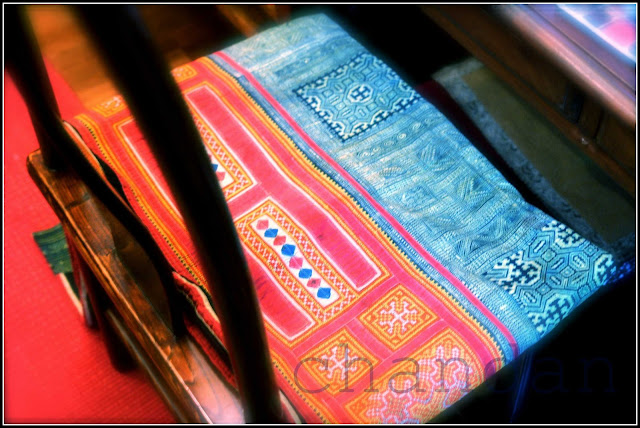


Flat cushion made from a Hmong jacket
A visit to the weekly Hmong market in  Luang Prabang, Laos, was another occasion to arrest lasting images of a very colourful people out in their finery. 

Over all the trips I have come back with stashes of textiles. Posting a few pictures from around the house and a slide show of images from  Vietnam and Laos.


 A child's cap embellished with wool, metal, and old coins : Red Yao tribe

Besides the colourful flamboyant clothing, the hill people use jewellery and accessories extensively, a subject that will take up an entirely different post.

Monday, February 2, 2009

Warp and weft : Indonesian Ikat


Posting first on a series on traditional weaves  from Asia.
Traditional textiles are among the most exciting and sought after categories of traditional art from around the region.
There is  much to offer- a profusion of techniques, fabrics,  raw materials, motifs, patterns and applications.
Most traditional weaves are durable, and lend themselves to excellent use around the modern home. Decorating with kaleidoscopic colours of  indigenous textiles rich in texture and imagery is rewarding not only for the visual appeal it generates, but for the fact that it helps sustain age old craft traditions and low-income rural economies.
Featured today are a few weaves from Indonesia. The archipelago's various people have age old weaving traditions. Most weaving is carried out by men and women at home using back-strap looms of varying complexity    


Among the noted weaves from different Indonesian islands are the Balinese Songket and Rangrang, West Timorese and Sumbanese Pahikung, West Timorese Buna and the exceptional Ikat. Ikat derives its name from the Malay word Meningkat which means to tie or bind. Originally introduced to the archipelago from India, by the British East India Company, the tradition dates back to 700 A.D.
It is a complex weave in which the warp and weft threads are dyed separately before each cloth is woven . The typical, blurry outlined patterns that distinguish the end product only begins to emerge when the individually dyed warp and weft threads are woven together. The skill behind the process lies in the ability to work out before hand where the dyed sections will intersect and what patterns they will create. In Tengenan, Bali, weavers  tie and dye the same pattern on both the warp and weft, a technique called double Ikat.

For the fact that they used very basic raw materials, like bark and fronds, Ikats from Indonesia         display ingenious creativity. 


Used traditionally to weave lengths of fabrics for a variety of uses-  royal and ceremonial regalia, sarongs and hinnggyi's and other items of clothing- Ikat has always been considered a powerful medium to tell stories, preserve memories, provide people with their indigenous identities and to work magic. In various parts of Indonesia, exceptionally woven pieces with intricate patterns were said to process magical powers and were used as talismans for luck and protection.


The weave is s replete with motifs like conch shells, birds, fishes, flowers, animal and human figures.  Expressive and very dramatic figures representing deamons and other mythological characters also abound.


Indonesian Ikat also comes in a veritable feast of colours, Sumbanese rusty reds and deep blues in bold patterns. In rainbow stripes from Timor and deep browns, oranges and navy blue from the islands of Alor, Flores and Savu.


Images top to bottom.
  • Cotton sarongs from Jepara, Java, Sumba motif.
  • Here, two sarongs have been opened up and joined in the middle to make a bedspread.
  • Cotton throw from Bali.
  • Silk sarong 
  • Silk Sarong, detail.
  • Cotton, sheet from Java, used as table cloth.
  •  Tapestry and runner in cotton and hemp, Bali.
For more images and information on ikat and other Indonesian textiles refer to the site below.

LinkWithin

Related Posts Widget for Blogs by LinkWithin